
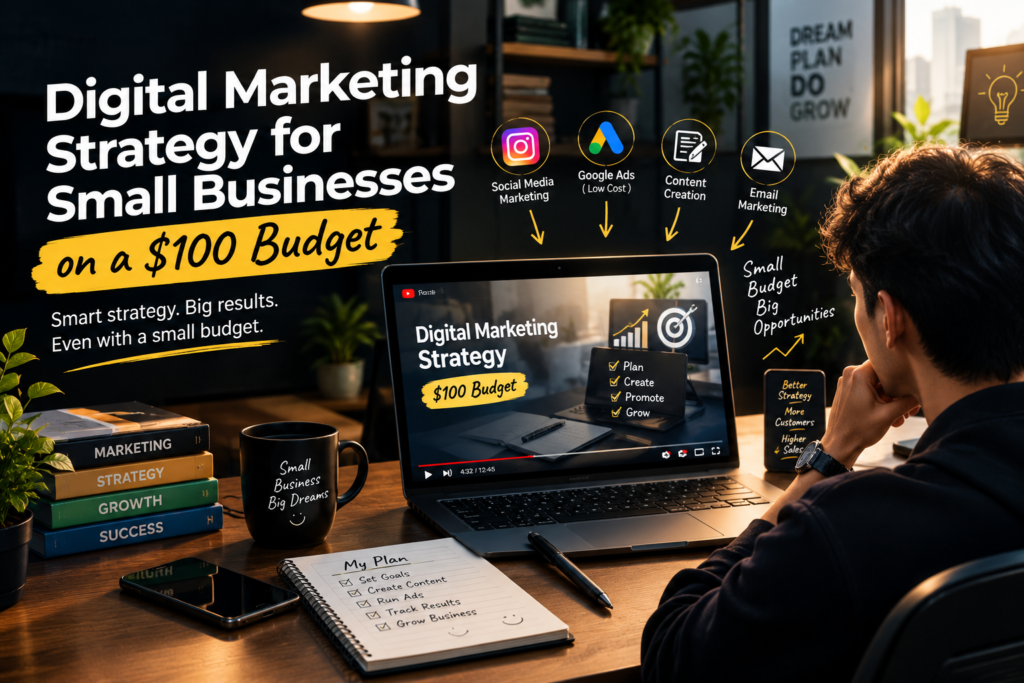
Digital Marketing Strategy for Small Businesses
Digital marketing is often seen as something that requires a large budget. However, small businesses can start building an online presence without spending thousands of dollars. With a carefully planned strategy, even a $100 budget can be used to reach potential customers, build brand awareness, and generate sales.
The key is not how much money you spend, but how effectively you use it.
In this blog, we will explore a simple digital marketing strategy for small businesses that can be implemented with a $100 budget.
- Build a Strong Online Presence
Before spending money on advertising, make sure your business can be easily found online.
Create and optimize your social media profiles on platforms where your target customers are active. Depending on your business, this could include Instagram, Facebook, TikTok, LinkedIn, or YouTube.
Make sure your profile includes:
Business name and logo
Clear description of your products or services
Contact information
Location, if you serve a local area
Link to your website or ordering page
A professional online presence helps potential customers understand your business quickly and builds credibility.
- Create a Simple Content Strategy
You don’t need expensive equipment or a professional studio to create marketing content.
A smartphone can be enough to create photos, videos, Reels, and other social media content.
Focus on content that provides value rather than constantly promoting your products.
For example, you can create:
Product demonstrations
How-to videos
Customer testimonials
Behind-the-scenes content
Helpful tips
Frequently asked questions
Before-and-after posts
Try to create content consistently throughout the month.
- Use Free Marketing Tools
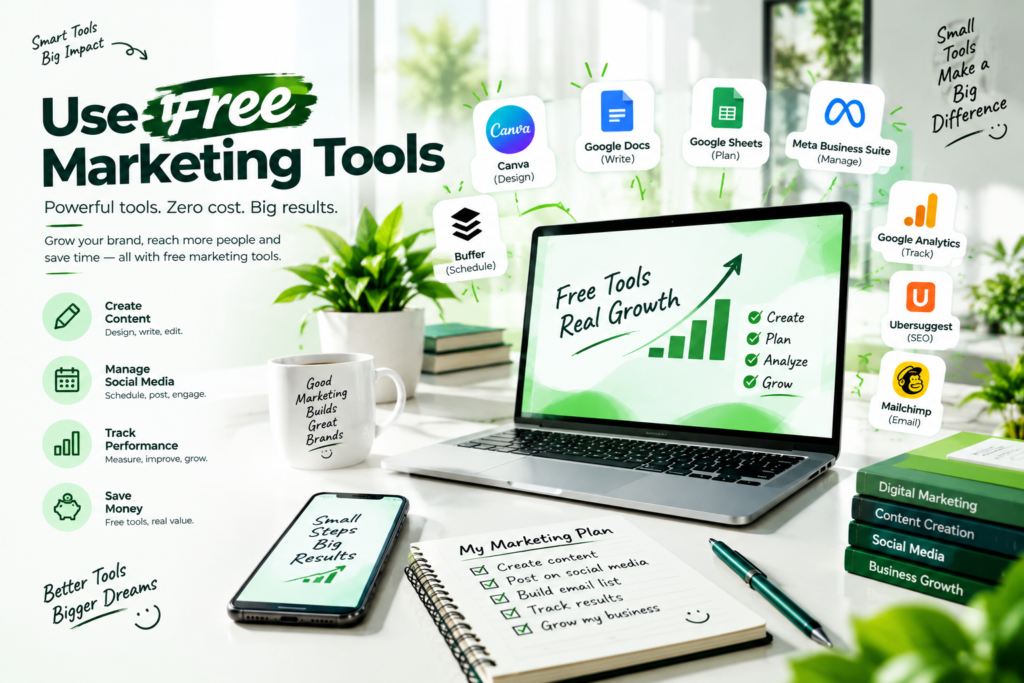
One of the best ways to make a $100 budget go further is to take advantage of free tools.
You can use free tools for tasks such as:
Designing social media posts
Editing short videos
Planning content
Managing social media
Checking website performance
Analyzing social media engagement
Using free tools for everyday tasks allows you to save your budget for activities that have a direct impact on growth.
- Spend $30 on a Small Paid Advertising Test
Don’t spend your entire budget on one advertisement.
Instead, start with a small test campaign. For example, you could spend around $30 promoting your best-performing product, service, or social media post.
Target people who are most likely to become customers based on factors such as location, interests, or demographics.
After the campaign ends, analyze the results before spending more money.
- Invest $20 in Creating Better Content
If you already have basic equipment, you may not need to spend anything here. But a small investment can sometimes improve the quality of your marketing.
For example, you could spend $20 on simple content-creation resources such as basic lighting, templates, or other useful tools.
The goal is not to make your content look expensive. It is to make it clear, attractive, and professional.
- Use $20 for Local Marketing
If your business serves a specific local area, focus part of your budget on reaching nearby customers.
You could use $20 for a small local promotion or social media campaign targeted toward people in your service area.
Local businesses can also benefit from free activities such as:
Creating a Google Business Profile
Asking customers for reviews
Posting in relevant local communities
Building relationships with nearby businesses
Encouraging customers to share your products
These activities can help increase visibility without requiring a large advertising budget.
- Partner With Small Creators
Influencer marketing doesn’t always require working with celebrities.
Small businesses can consider collaborating with local or niche content creators who have a relevant audience.
For example, instead of paying a large influencer, you could use part of your budget for a small creator collaboration.
Pay more attention to audience relevance and engagement rather than focusing only on the number of followers.
A creator with a smaller but highly relevant audience may be more useful to your business than someone with thousands of unrelated followers.
- Keep $30 for Testing and Optimization
One of the biggest mistakes small businesses make is spending their entire marketing budget immediately.
Keep around $30 available for testing different ideas.
You could test:
Two different ad designs
Different headlines
Different offers
Different audiences
Different types of content
Once you identify what performs best, put more effort into that strategy.
Example $100 Budget
Marketing Activity
Budget
Paid advertising test
$30
Content creation
$20
Local promotion
$20
Creator collaboration
$0–$20
Testing and optimization
$30
Total
$100
The exact allocation can change depending on your business. For example, an online business may benefit more from advertising, while a local business may benefit more from local promotions and customer reviews.
- Measure Results, Not Just Likes
Likes and followers can be useful indicators, but they don’t always translate into business growth.
Monitor the key performance metrics that are important for your business.
such as:
Website visits
Messages and inquiries
Leads
Product purchases
Conversion rate
Cost per customer
Return on advertising spend
For example, if you spend $30 on advertising and generate $100 in sales, you have valuable information about the performance of that campaign.
- Focus on Long-Term Growth

A $100 budget won’t magically transform a business overnight. The purpose of a small budget is to test strategies, understand your audience, and discover what works.
Once you find a strategy that generates good results, you can gradually reinvest your profits into marketing.
For example:
Start with $100 → Test → Measure → Improve → Reinvest → Grow
This approach helps small businesses avoid wasting money and build a sustainable digital marketing strategy.
Conclusion
Small businesses don’t need a huge marketing budget to get started with digital marketing. With just $100, you can build an online presence, create useful content, test paid advertising, reach local customers, collaborate with creators, and learn which strategies generate results.
The most important thing is to start small, measure everything, and continuously improve.
A small budget combined with a smart strategy can be more powerful than a large budget without a clear plan.
11. Build a Simple Website or Landing Page
A website helps customers learn more about your business and find important information in one place. You don’t always need to invest a lot of money to create one.
Start with a simple website or landing page that explains what your business offers.
Include important details such as:
- Business introduction
- Products or services
- Product images and descriptions
- Contact information
- Customer reviews
- Clear call-to-action buttons
For example, if you run an online clothing store, your landing page can display your latest collections, prices, and ordering details.
A clear and user-friendly website can help turn visitors into potential customers.
12. Improve Your Website with Basic SEO
Search Engine Optimization (SEO) helps your website appear in search engine results when people look for products or services related to your business.
You don’t need a large budget to start with basic SEO. Focus on simple improvements that can make your website easier to discover.
Some important SEO activities include:
- Researching relevant keywords
- Writing useful website content
- Creating attractive page titles and descriptions
- Optimizing product images with descriptive alt text
- Improving website loading speed
- Making your website mobile-friendly
For example, a local clothing store can create content around phrases such as “men’s clothing store near me” or “affordable men’s fashion.”
SEO takes time, but consistent improvements can help attract visitors without paying for every click.
13. Use Email Marketing to Connect with Customers
Email marketing is a useful way to maintain relationships with existing and potential customers.
You can collect email addresses through your website, online forms, or customer subscriptions, with their permission.
Once you have a small email list, share useful updates such as:
- New product announcements
- Special offers and discounts
- Business updates
- Helpful tips
- Seasonal promotions
For example, an online store can send an email to customers when a new clothing collection becomes available.
Start with free email marketing tools and focus on sending relevant messages instead of too many promotional emails.
14. Turn Existing Customers into Repeat Customers
Getting a new customer is important, but encouraging existing customers to return can also support business growth.
Small businesses can build customer relationships through simple activities that require little or no investment.
Consider these ideas:
- Provide friendly customer service
- Respond to customer questions quickly
- Share useful product information
- Offer occasional discounts to returning customers
- Ask customers for honest feedback
- Keep customers informed about new products
For example, a small clothing business can inform previous customers about new arrivals or special seasonal collections.
Happy customers may also recommend your business to friends and family, helping you reach more people naturally.
15. Create a 30-Day Digital Marketing Action Plan
A simple monthly plan can help you use your $100 budget more effectively. Instead of trying everything at once, divide your marketing activities into manageable steps.
Week 1: Build Your Foundation
- Set up professional social media profiles
- Create or improve your website
- Identify your target audience
- Research competitors
- Prepare your first batch of content
Week 2: Start Creating and Sharing Content
- Publish useful social media posts
- Create short videos and product demonstrations
- Share customer questions and answers
- Improve your website content
- Begin building an email list
Week 3: Test Your Marketing Campaigns
- Launch a small paid advertising campaign
- Test different images and headlines
- Try reaching a local audience
- Monitor messages, clicks, and website visits
Week 4: Analyze and Improve
- Review your advertising performance
- Identify your best-performing content
- Check customer engagement
- Compare spending with results
- Plan your next month’s activities
Following a monthly plan helps you stay organized and understand which activities are worth continuing.
16. Avoid Common Digital Marketing Mistakes
A small marketing budget should be used carefully. Even a good strategy can fail if you make avoidable mistakes.
Here are some common mistakes small businesses should avoid:
Spending Without a Clear Goal: Before launching an advertisement, decide whether you want website visits, customer inquiries, leads, or sales.
Targeting Everyone: Trying to reach everyone can waste your budget. Focus on people who are most likely to need your products or services.
Ignoring Customer Messages: Responding late to inquiries can result in lost sales. Try to answer customer questions as quickly as possible.
Posting Without Consistency: Publishing content regularly helps customers recognize and remember your business.
Ignoring Performance Data: Don’t judge a campaign only by likes or views. Check whether it brings useful inquiries, leads, and sales.
Avoiding these mistakes can help you make better decisions and get more value from your marketing budget.